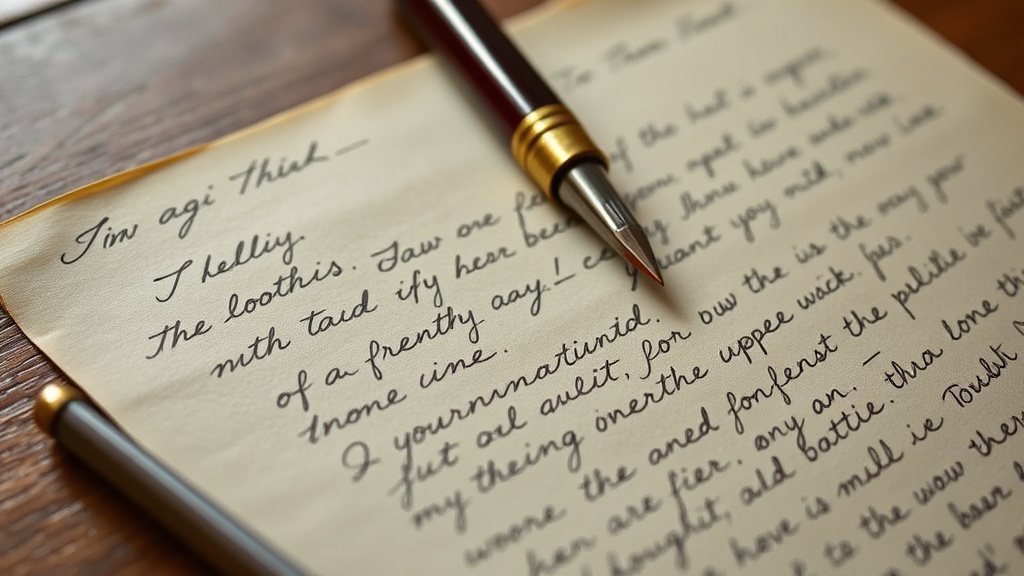
The Lost Art of Handwritten Letters: A Journey Through Epistolary History

This guide explores the rich history of handwritten correspondence—from ancient clay tablets to Victorian love letters—and examines why reviving this practice matters in an age of instant messaging. You'll discover the cultural significance of epistolary traditions, practical ways to start writing letters today, and how this timeless art form can deepen personal connections in ways digital communication simply can't replicate.
What Is Epistolary History and Why Does It Matter?
Epistolary history is the study of letter writing as a cultural practice throughout human civilization. It's a window into how people thought, felt, and connected across distances before telephones existed. The significance runs deep—letters have shaped political movements, preserved literary masterpieces, and offered intimate glimpses into everyday lives long past.
Consider this: the oldest known handwritten letter dates back to around 2400 BCE. A Sumerian scribe pressed cuneiform symbols into clay, sending instructions to a supplier. Fast forward four millennia, and Abraham Lincoln's letters helped preserve a nation. Virginia Woolf's correspondence offers some of the sharpest literary criticism ever penned. These weren't just messages—they were artifacts of human experience.
The epistolary tradition peaked during the 18th and 19th centuries. Postage reforms in Britain (the Penny Black stamp of 1840) and America made sending mail affordable for ordinary people. Letter writing became a social skill taught in schools, a mark of educated refinement. Households maintained "letter books"—copied records of correspondence, preserving family narratives across generations.
That said, the decline has been steep. The United States Postal Service delivered 212 billion pieces of mail in 2001. By 2023, that number plummeted to 116 billion—and personal letters represent a tiny fraction of what's left. (Mostly bills and junk mail now, if we're honest.) The art hasn't disappeared entirely, though. A quiet revival is bubbling among stationery enthusiasts, history buffs, and anyone craving connection that outlasts a swipe.
How Did Famous Letters Shape History and Culture?
Letters have altered the course of wars, sparked revolutions, and given us some of history's most enduring words. Albert Einstein's 1939 letter to President Roosevelt warned about Nazi nuclear research—directly influencing the Manhattan Project. Martin Luther King Jr.'s "Letter from Birmingham Jail" became a foundational text of the civil rights movement, written on margins of a newspaper because that was all he had.
The literary world owes enormous debts to correspondence. James Joyce's Ulysses might never have been published without letters—Sylvia Beach discovered the manuscript through Joyce's correspondence and published it through her Paris bookshop, Shakespeare and Company. The love letters between Napoleon Bonaparte and Joséphine remain achingly passionate documents of romantic obsession. (He wrote to her multiple times daily during campaigns. She sometimes didn't reply for weeks.)
Famous correspondences worth exploring:
- Abelard and Heloise — 12th-century philosopher and his student, their letters scandalized medieval Europe
- John and Abigail Adams — over 1,100 letters documenting American independence and a remarkable marriage
- Vincent van Gogh and Theo van Gogh — 820 letters revealing the artist's struggles and theories
- Simone de Beauvoir and Jean-Paul Sartre — decades of philosophical partnership and complex romance
- Hunter S. Thompson and various correspondents — collected in The Proud Highway, showing gonzo journalism's raw origins
Museums now treasure these documents. The Morgan Library & Museum in New York holds one of the world's finest letter collections—from Jane Austen's sarcastic family notes to Charlotte Brontë's anxious pleas to her publisher. These papers carry something emails never will: the physical presence of the writer. You see hesitation in crossed-out words. You sense urgency in hastier script. The paper itself—watermarked, aged, sometimes tear-stained—speaks volumes.
What Materials Do You Need to Start Writing Letters?
The barrier to entry is remarkably low. Quality paper, a reliable writing instrument, envelopes, and stamps—these basics will carry you far. But the world of correspondence offers rabbit holes aplenty for those who wish to explore.
Here's the thing: you don't need fountain pens and Italian stationery to write meaningful letters. A ballpoint on notebook paper beats silence every time. That said, the right tools can transform the experience into something you'll genuinely anticipate.
| Material | Budget Option | Investment Option | Best For |
|---|---|---|---|
| Paper | Strathmore Writing Pad ($8) | Clairefontaine Triomphe ($18/50 sheets) | Smooth writing, no feathering |
| Pen | Uniball Jetstream ($3) | Pilot Custom 74 Fountain Pen ($160) | Daily writing vs. ceremonial notes |
| Ink | Standard cartridge refills | Robert Oster Fountain Pen Ink ($20) | Archival quality, unique colors |
| Envelopes | Mead Security Envelopes ($6/50) | Crane & Co. Pearl White ($25/25) | Professional vs. elegant presentation |
| Sealing Wax | Manuscript Sealing Wax Sticks ($10) | J. Herbin Supple Sealing Wax ($15) | That satisfying medieval flourish |
Worth noting: local shops often stock surprising treasures. Paper Muse in Halifax carries Canadian-made letterpress stationery. The Goulet Pen Company (based in Virginia) ships worldwide and offers exceptional guidance for beginners. Don't overlook antique stores—vintage correspondence cards often sell for pennies, and pre-stamped international reply coupons from the 1960s make charming enclosures.
The catch? Stationery can become a hobby that eclipses the actual letter writing. (Many enthusiasts own drawers of beautiful paper they've never touched.) Start simple. Add tools as your practice deepens.
How Can You Make Your Letters Meaningful and Memorable?
Great letters share certain qualities regardless of era or author: specificity, honesty, and attention to the recipient. General updates ("Work is busy, weather is fine") waste everyone's time. Instead, zoom in on particulars. Describe the sound of rain against your window. Mention a song stuck in your head. Recall a shared joke from 2007.
Structure helps. Consider this loose framework:
- Open with presence — acknowledge the gap since your last exchange, or something specific you noticed about the recipient recently
- Offer substance — one story, one question, one observation that's been pressing on your mind
- Build connection — reference shared history, express something genuine about your relationship
- Close with intention — suggest next steps (a call, a visit, your next letter) without pressure
Handwriting adds irreplaceable personality. Your loops and slants, the pressure variations, the occasional crossed-out word—these create intimacy that typed text cannot replicate. Studies (limited but intriguing) suggest handwritten notes activate different emotional processing in readers. The brain recognizes the effort, the physicality, the singular attention.
That said, don't let imperfect penmanship stop you. Flaubert had terrible handwriting—his friends complained constantly. Emily Dickinson's letters often ran perpendicular across already-filled pages to save paper. These quirks became part of their charm.
Practical tips for letters people keep:
- Include ephemera—a pressed flower, a concert ticket, a newspaper clipping that made you think of them
- Write at unusual moments—waiting rooms, early mornings—when your mind wanders interesting places
- Ask questions that invite lengthy replies; "How are you?" yields less than "What are you reading?"
- Date your letters meticulously; future archivists (or your grandchildren) will thank you
- Sign off creatively—"Until the next page," "With ink-stained fingers," "Hastily but warmly"
Where Can You Find Pen Pals and Letter-Writing Communities?
The internet—ironically—has become the best place to find analog correspondence partners. Niche communities connect writers across continents, often around specific interests that spark genuine connection.
The r/penpals subreddit maintains over 200,000 members posting detailed profiles seeking matches. The League of Extraordinary Penpals (now called Letter Writers Alliance) offers structured introductions and monthly writing prompts. For literary-minded correspondents, the Letters of Note website's newsletter sometimes facilitates exchanges between readers.
Offline opportunities abound too. The Smithsonian's annual Museum Day often includes letter-writing workshops at participating institutions. Local libraries—Halifax Public Libraries included—occasionally host correspondence clubs. Coffee shops in university towns frequently have bulletin boards with "pen pal wanted" notices.
Some writers prefer "slow dating" apps like Slowly, which deliberately delay message delivery to simulate postal timing. (A letter to Australia takes roughly a day to "arrive" in the app.) Others join organized exchanges: InCoWriMo (International Correspondence Writing Month) challenges participants to write and mail 30 letters in February.
The most enduring correspondences often start with shared passion. Book clubs generate letter exchanges—discussing Piranesi by post hits different than in-person debate. Travelers collect addresses from hostel common rooms, promising to share photos when developed. Grandparents write to grandchildren, preserving family history in real-time. There's no wrong entry point.
Start with one letter this week. Not a text masquerading as thoughtfulness—actual paper, actual stamp, actual walk to a mailbox. The recipient's surprise alone justifies the effort. That something tangible survives in their drawer for years? That's the lost art, found again.