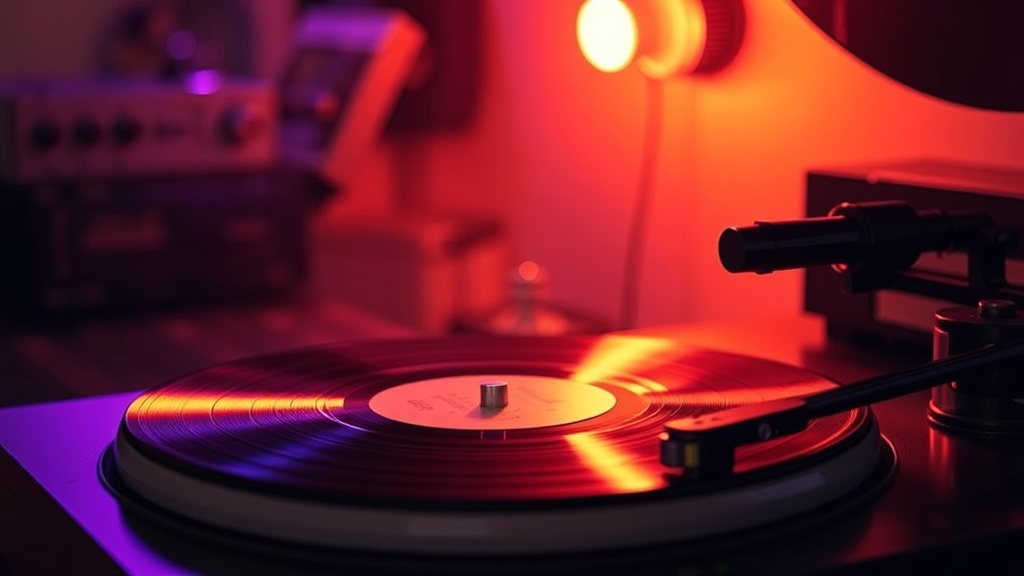
Why Vintage Vinyl Sounds Warmer: The Science Behind Analog Magic

Quick Tip
Vinyl's warm sound comes from natural harmonic distortion and the physical groove capturing continuous analog waves rather than digital samples.
Why Does Vinyl Sound Warmer Than Digital?
This post breaks down the science behind analog warmth—what it actually means, why it happens, and whether that "vintage vinyl sound" lives in the grooves or in the listener's head. Anyone curious about audio quality, music history, or why that 1973 Pink Floyd pressing feels different from a Spotify stream will find concrete answers here.
What Causes the "Warm" Sound in Vinyl Records?
The warmth comes from harmonic distortion and frequency response curves inherent to analog playback. When a stylus tracks the grooves of a record, it generates subtle even-order harmonics—particularly second-order distortion—that the human ear finds pleasant and musical. Digital audio, by contrast, aims for clinical transparency.
Mastering engineer Bob Katz has documented how vinyl's physical limitations actually shape the sound in desirable ways. The cutting lathe can't handle excessive bass in the center of the groove (it causes the needle to jump), so engineers roll off low frequencies during mastering—and boost them back during playback via the RIAA equalization curve. This process introduces phase shifts and subtle compression that smooth out transients.
The catch? Not all warmth is intentional. Surface noise, groove wear, and cartridge resonance color the sound too. That "vintage vinyl sounds warmer" experience often blends authentic harmonic character with the artifacts of aging media.
Is Analog Actually Better Than Digital Audio?
Not objectively—different formats serve different purposes. Digital audio (CD-quality 16-bit/44.1kHz and beyond) captures a wider frequency range and dynamic range than vinyl can physically reproduce. The Audio Engineering Society confirms that well-mastered digital files contain more accurate information.
That said, preference isn't about specifications alone. Studies at McMaster University show listeners often describe analog playback as "more involving" or "easier to listen to for long periods." The technical imperfections create a forgiving, saturated quality that flatters certain recordings—particularly jazz, soul, and classic rock mastered during the analog era.
| Characteristic | Vinyl (Analog) | Streaming (Digital) |
|---|---|---|
| Frequency Response | 30Hz–20kHz (limited by groove geometry) | 20Hz–20kHz+ (theoretically unlimited) |
| Dynamic Range | ~60-70 dB | ~96 dB (16-bit) to 144 dB (24-bit) |
| Harmonic Distortion | 0.1–2% (even-order, musical) | <0.001% (minimal) |
| Noise Floor | Surface hiss, crackle (-60 dB typical) | Nearly silent (-120 dB typical) |
| Notable Examples | Original Dark Side of the Moon pressings, Blue Note Tone Poet series | Tidal Masters, Apple Music Lossless |
Why Do Audiophiles Still Prefer Turntables Over Streaming?
The ritual matters. Playing a record demands attention—removing the disc from its sleeve, cleaning the surface, lowering the tonearm. This physical engagement creates psychological investment. Here's the thing: when you've worked to hear something, you tend to listen more carefully.
Hardware plays a role too. Quality turntables like the Pro-Ject Debut Carbon EVO or Rega Planar 3 (both popular at Taz Records in Halifax) extract more nuance from grooves than budget Crosley suitcase players. A decent phono preamp—something like the Schiit Mani or Pro-Ject Phono Box—adds gain and applies proper RIAA equalization without introducing excessive noise.
Worth noting: The "warmth" debate often confuses format with mastering. Many contemporary vinyl releases are cut from the same loud, compressed digital masters used for streaming. To hear authentic analog character, seek out records cut from tape—look for "AAA" (analog recording, mixing, mastering) in the dead wax or buy original pressings from the 1960s–1980s.
There's no wrong way to enjoy music. Some evenings call for flipping through crates at Taz on Barrington Street. Others suit queueing up a playlist while cooking. The science behind analog magic doesn't demand allegiance—it just explains why that crackle before the first note hits feels like coming home.